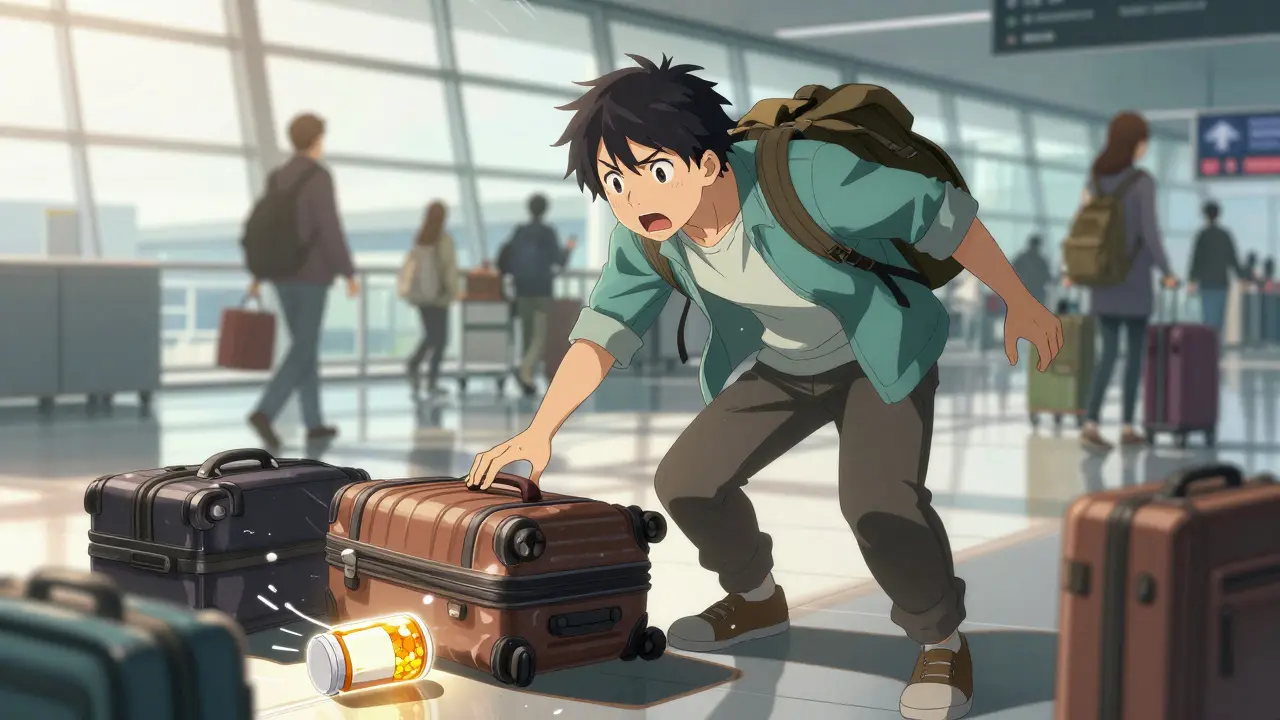
Running out of medication while traveling isn’t just inconvenient-it can be dangerous. If you’re abroad and your pills are stolen, lost in baggage, or left behind, you don’t have to panic. But you do need to act fast and know exactly what to do. The process isn’t the same everywhere, and some medications simply can’t be replaced without the right paperwork. Here’s how to handle it, step by step.
Step 1: Stay Calm and Check Your Belongings
- Search every bag, pocket, and compartment. Sometimes meds are just misplaced-not gone.
- If you flew, contact your airline’s baggage service immediately. Airlines require reports within 24 hours to start tracking lost luggage under IATA Resolution 701.
- If your meds were stolen, go to the nearest police station and file a report. You’ll need this for insurance claims, whether it happened at a hotel, on public transport, or in a public space.
Don’t wait. Every hour counts when you’re running low on blood pressure pills, insulin, or antidepressants.
Step 2: Contact Your Travel Insurance Provider
If you have comprehensive travel insurance, this is your first real lifeline. About 68% of top-tier plans include prescription replacement coverage, with limits between $500 and $1,000 per incident. Basic plans usually don’t cover this at all.
Call the 24/7 assistance line listed on your card. Companies like Allianz Travel Insurance and MedAire have teams that can:
- Connect you with local doctors who understand international prescription rules
- Verify your original prescription with your home physician
- Arrange for a local clinic to issue a new prescription legally
Travelers who use insurance assistance get meds within 24 hours 78% of the time. Those who try alone? Only 42% succeed.
Step 3: Gather Your Documentation
This is the most overlooked step-and the most critical.
Before you leave home, carry:
- A letter from your doctor listing all medications, dosages, and why you need them (use generic names, not brand names)
- Copies of your original prescriptions
- Your meds in original containers with pharmacy labels showing your name and the doctor’s info
Why? Because 89% of countries won’t fill a foreign prescription. And 92% of travel medicine specialists say this documentation cuts replacement time by more than half. A 2023 study in the Journal of Travel Medicine found travelers without these papers took 3.7 times longer to get their meds.
Step 4: Find a Local Doctor
You can’t walk into a pharmacy abroad and just ask for your U.S. prescription. Most countries require a local doctor to examine you first.
Here’s what to expect:
- In Western Europe: Doctors are used to treating travelers. You’ll likely get a new prescription in under 12 hours.
- In Southeast Asia or Africa: You may need an in-person visit. About 76% of local doctors there won’t prescribe without seeing you.
- For chronic conditions like diabetes, heart disease, or mental health: Expect a full check-up. Doctors are cautious with unfamiliar meds.
Don’t assume your U.S. dosage is the same. A pill labeled “10mg” in one country might be 5mg or 20mg in another. Always confirm the strength with the pharmacist.

Step 5: Watch Out for Counterfeit Drugs
One in three medications in parts of Southeast Asia and Africa are fake, according to the World Health Organization. These can be empty capsules, wrong chemicals, or even toxic substances.
How to avoid them:
- Only buy from licensed hospitals or pharmacies with visible government approval signs
- Check the packaging: spelling errors, blurry print, or missing batch numbers are red flags
- Ask the pharmacist to open a sealed package in front of you
When in doubt, ask your insurance provider or embassy to recommend a trusted pharmacy. The CDC warns that counterfeit drugs cause about 500,000 deaths worldwide every year.
Step 6: Know the Rules on Controlled Substances
Some meds just can’t be replaced abroad-no matter what.
Under U.S. federal law, Schedule II drugs like Adderall, Ritalin, OxyContin, and Vicodin cannot be refilled under any circumstances. Even in the U.S., you need a new prescription. Abroad? Forget it.
Here’s what works:
- Non-controlled meds (antibiotics, blood pressure pills, birth control): Usually replaceable with a local doctor’s note.
- Controlled substances: Only possible if you have a U.S. doctor on telehealth (like MyUSADr), but even then, DEA rules block them from prescribing these drugs remotely.
Plan ahead. If you rely on controlled meds, bring at least two weeks extra. Never pack them in checked luggage.
Step 7: Prepare for Temperature-Sensitive Medications
Insulin, epinephrine, and some biologics can spoil if they get too hot or too cold.
Travel tips:
- Carry a portable cooling pack (like a Frio wallet) and keep meds in your carry-on
- Avoid leaving them in a hot car or near a window
- 41% of travelers report reduced effectiveness after exposure to extreme temps
Some countries have strict rules about bringing refrigerated meds across borders. Check ahead.

Step 8: Know the Local Rules Before You Go
What’s legal in the U.S. might be illegal-or strictly controlled-elsewhere.
Examples:
- Pseudoephedrine (in cold meds): Banned in Thailand without a prescription
- Codeine: Available over-the-counter in the UK, but requires a prescription in the U.S.
- Many antidepressants: Require special permits in Japan and Australia
Check the CDC’s Yellow Book 2024 or your country’s travel advisory site before departure. 31% of medication emergencies could be avoided with simple pre-trip research.
Step 9: Always Carry Extra
IATA data shows 1 in 150 checked bags are mishandled. That’s not rare-it’s predictable.
Always carry at least a 7-day supply in your carry-on. Even if you’re only going for a weekend. Pack extra pills in a separate bag, just in case.
For long trips (over 30 days), 22% of travelers face medication access issues. Cardiovascular, psychiatric, and diabetes meds are the most commonly affected.
Step 10: Use Digital Tools-But Don’t Rely on Them
Apps like Medisafe let you store digital copies of prescriptions using blockchain. Over 5 million people use them.
But here’s the catch: Only 17% of countries accept digital prescriptions as legal documentation. A printed copy with your doctor’s signature still carries more weight.
Use apps as backup-not your primary plan.
What It Costs to Replace Medications Abroad
Costs vary wildly:
- Western Europe: $75-$150
- Latin America: $120-$200
- Southeast Asia: $40-$90
If you don’t have insurance, you’re paying out of pocket. That’s why comprehensive travel insurance isn’t optional-it’s essential.
Can I get my prescription refilled at a foreign pharmacy?
Almost never. Over 89% of countries refuse to fill prescriptions issued outside their borders. You need a local doctor to examine you and write a new prescription. Even if the drug name matches, the legal system doesn’t recognize foreign paperwork.
What if I lost my medications and don’t have travel insurance?
You’ll need to find a local clinic or hospital and pay out of pocket. Bring your doctor’s letter and prescription copies to speed things up. The cost will depend on the country and medication, but expect $40-$200. It’s expensive, but possible. Without documentation, you may wait days or be turned away.
Can I use telehealth to get a new prescription while abroad?
Only for non-controlled substances, and even then, it’s tricky. U.S. telehealth services like MyUSADr can prescribe antibiotics, birth control, or blood pressure meds-but not opioids, stimulants, or other Schedule II drugs. DEA rules block remote prescribing of these, even if you’re a long-time patient. And the local pharmacy still needs to accept the e-prescription, which isn’t guaranteed.
Is it safe to buy medication from a local market or street vendor?
No. The World Health Organization estimates 1 in 10 medications in developing countries are counterfeit. Some contain no active ingredient, others have dangerous chemicals. Even if it looks right, don’t risk it. Always use a licensed pharmacy with visible government certification. Your health isn’t worth the gamble.
What should I do if I’m traveling with insulin or other temperature-sensitive drugs?
Carry at least a 7-day supply in your carry-on, with a cooling device like a Frio wallet. Keep them away from direct sunlight and extreme heat. Never check them in luggage. Some countries require a doctor’s note for insulin, so bring one. Temperature issues affect 41% of travelers-planning prevents crises.





Write a comment
Your email address will be restricted to us