
Why would a patient pay $200 for a prescription when an identical generic version costs just $15? It doesn't make sense from a purely financial standpoint. Yet this happens every day in pharmacies across the country. The answer isn't that patients are irrational or ignorant; it's that human decision-making is messy, emotional, and heavily influenced by psychological shortcuts we didn't even know we were using.
This is where behavioral economics comes in. Unlike traditional economic models that assume people always act in their best financial interest, behavioral economics looks at how real humans actually behave. It combines psychology with economics to explain why we stick with expensive treatments, ignore cheaper alternatives, or forget to take life-saving medications altogether. Understanding these hidden drivers is no longer optional for healthcare providers-it's essential for improving health outcomes and reducing the staggering $289 billion annual cost of medication non-adherence in the U.S. healthcare system.
The Psychology Behind the Prescription Bottle
To understand patient drug choices, you first have to look past the price tag. In the early 2000s, scholars like Daniel Kahneman and Amos Tversky laid the groundwork for what we now call prospect theory. They discovered that people feel the pain of a loss about twice as intensely as the pleasure of a gain. This concept, known as loss aversion, plays a massive role in pharmacy aisles and doctor's offices.
When a doctor suggests switching a patient from a brand-name drug to a generic, the patient often perceives this not as saving money (a gain), but as losing the perceived quality or safety of their current treatment (a loss). Research shows that 68% of patients will keep taking a more expensive regimen even if an equally effective alternative costs 30% less. They aren't trying to waste money; they are trying to avoid the risk of getting worse. This fear overrides logic.
Then there is confirmation bias. If a patient believes that "expensive equals better," they will seek out information that confirms this belief while ignoring data that contradicts it. A 2022 study found that prescription drug prices have risen 47% faster than general inflation since 2010, yet many patients still associate higher costs with superior efficacy. This bias makes it incredibly difficult for clinicians to persuade patients to switch to cost-effective options without addressing the underlying psychological resistance.
How Cognitive Biases Sabotage Adherence
Choosing a drug is only half the battle. Taking it consistently is where most people fail. Only about 50% of patients take their medications exactly as prescribed. Behavioral economics identifies several specific biases that drive this non-adherence.
- Present Bias: Humans prefer immediate gratification over long-term benefits. Taking a pill today feels like an immediate hassle (cost), while the benefit (avoiding a heart attack in ten years) feels abstract and distant. This leads to 33% of prescriptions going unfilled entirely.
- Status Quo Bias: We tend to stick with our current situation because changing requires effort. Even when a new treatment plan is objectively better, the mental energy required to learn new dosing schedules or manage side effects creates friction. Patients simply default to doing nothing.
- Cognitive Load: Managing multiple medications is mentally exhausting. Data shows that adherence rates drop by 23.7% for patients on multi-drug regimens compared to those on a single drug. Every additional pill adds complexity, increasing the likelihood of errors or missed doses.
These aren't character flaws; they are predictable patterns of human behavior. When healthcare systems design policies based on the assumption that patients are rational calculators, those policies fail. But when they account for these biases, success rates skyrocket.
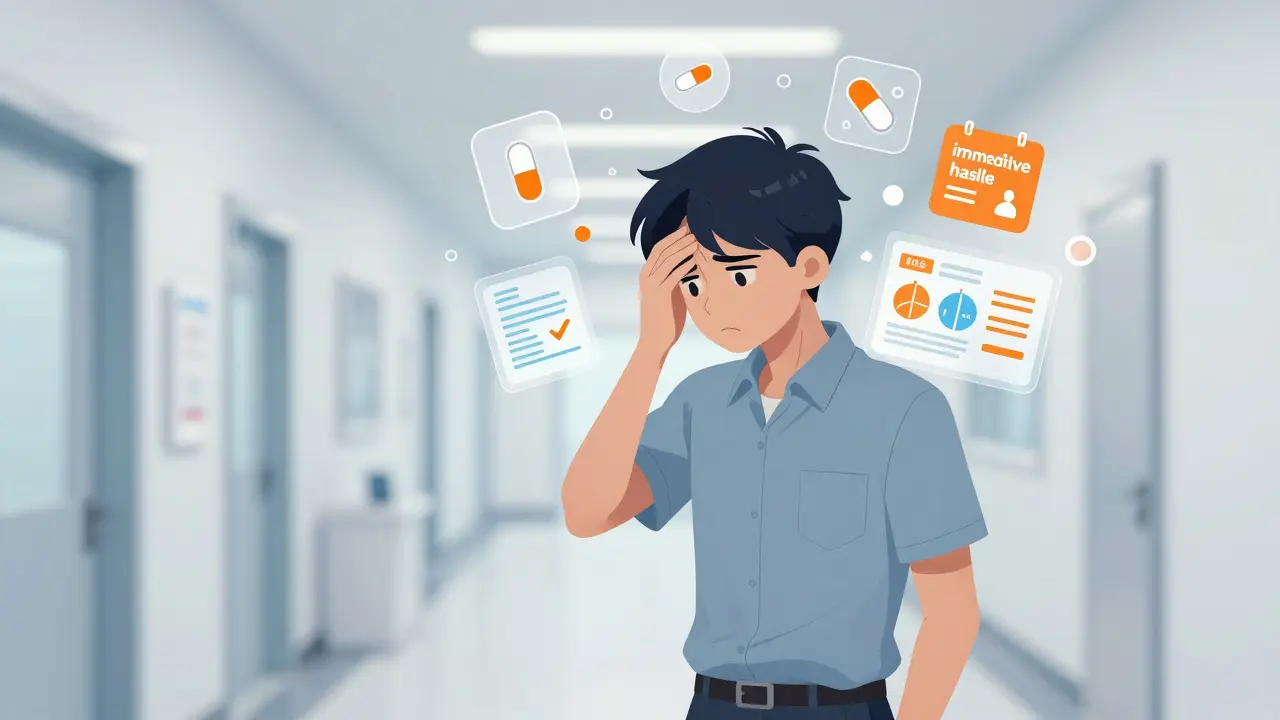
Nudges That Actually Work
If understanding the problem is step one, designing the solution is step two. The term "nudge" was popularized by Richard Thaler and Cass Sunstein in their 2008 book *Nudge*. A nudge is any aspect of the choice architecture that alters people's behavior in a predictable way without forbidding any options or significantly changing their economic incentives.
In clinical settings, the most powerful nudge is the default option. A 2012 study demonstrated that when hospitals changed their standard medication order sets to feature alternative drugs during shortages, appropriate substitutions increased by 37.8%. Doctors didn't need extra training or incentives; they just needed the easier path to be the right path. Defaults work because they leverage status quo bias for good.
Framing also matters immensely. How you present information changes how it is received. In vaccination campaigns, presenting vaccine efficacy as "95% effective" increases uptake by 18.4 percentage points compared to saying it is "5% ineffective." The math is identical, but the psychological impact is vastly different. One highlights survival; the other highlights failure.
Social norms can also drive change. In one HIV adherence study, clinics that publicly displayed adherence rates on posters saw a 22.3% improvement in patient compliance. People want to fit in and do what others are doing. Making healthy behaviors visible and normative creates a powerful peer pressure effect that education alone cannot achieve.
| Intervention Type | Average Adherence Improvement | Key Mechanism | |||
|---|---|---|---|---|---|
| Traditional Patient Education | 5-8% | Information provision | |||
| Social Norms Posters | 21.4% | Peer influence | |||
| Framing Effects | 17.2% | Perception shift | Defaults (Order Sets) | 28.6% | Reduced friction |
| Loss Aversion Rebates | 14.3% | Financial incentive structure |

Implementing Behavioral Strategies in Practice
Knowing what works is different from making it work in a busy clinic. Implementation requires careful planning and technology integration. For instance, SMS reminders are cheap ($8.25 per patient monthly) but less effective than smart pill bottles ($47.50 per patient monthly), which provide real-time feedback and leverage gamification. However, the higher cost of tech solutions must be weighed against the long-term savings from reduced hospitalizations.
One major hurdle is staff training. Integrating behavioral insights into Electronic Health Records (EHR) systems is notoriously difficult, with 78.3% of institutions reporting compatibility issues. Clinicians need support, not just directives. Programs that succeed typically spend 3-6 months developing protocols that align with existing workflows rather than adding new steps.
Furthermore, one size does not fit all. Behavioral interventions underperform in populations with severe mental health conditions. Depression and anxiety can reduce the effectiveness of standard nudges by 31.4%. For these patients, simpler, more supportive approaches are necessary. Polypharmacy is another barrier; each additional medication reduces adherence by 8.3%, suggesting that deprescribing (removing unnecessary meds) might be a more effective behavioral strategy than adding reminders.
The Future of Patient-Centered Care
The landscape of pharmaceutical policy is shifting. The FDA's 2023 draft guidance on 'Patient-Focused Drug Development' explicitly incorporates behavioral economics principles. Sponsors are now required to evaluate how dosing frequency and administration routes impact patient decision-making. This marks a significant move away from viewing patients as passive recipients of care to active participants whose cognitive load and preferences matter.
Looking ahead, machine learning is poised to personalize these nudges. Early pilot studies in 2023 suggest that algorithms predicting individual responsiveness to specific interventions could increase effectiveness by 42.3%. Imagine a system that knows Patient A responds to social proof, while Patient B needs financial loss aversion triggers, and tailors the communication accordingly.
As digital therapeutics grow-projected to see 300% growth between 2023 and 2026-the integration of behavioral science will become seamless. The goal isn't to manipulate patients, but to remove the invisible barriers that prevent them from staying healthy. By respecting how the human mind actually works, we can create a healthcare system that is not only more efficient but also more humane.
What is the most effective behavioral nudge for medication adherence?
Defaults are generally the most effective intervention. By setting the preferred action as the automatic choice (such as pre-selecting a generic drug on a prescription form), you leverage status quo bias. Studies show defaults can improve appropriate prescribing by an average of 28.6%, outperforming educational materials or simple reminders.
Why do patients choose expensive brand-name drugs over generics?
This is often driven by confirmation bias and loss aversion. Patients may believe expensive drugs are safer (confirmation bias) and fear that switching to a generic means losing the quality of their current treatment (loss aversion). These psychological factors often outweigh the financial incentive to save money.
How does loss aversion apply to healthcare incentives?
Loss aversion suggests that people are more motivated to avoid losses than to acquire gains. In healthcare, this can be applied through rebate systems where patients earn money back for adhering to their medication schedule. Framing the incentive as "don't lose your reward" has been shown to produce higher persistence rates than framing it as "earn a bonus."
Are behavioral economics interventions ethical?
Yes, provided they preserve liberty. As noted by experts like Dr. Aaron Kesselheim, nudges are ethical because they guide behavior without removing choice. Patients can still opt out of a default or ignore a reminder. The goal is to make healthy choices easier, not to force compliance.
What is the cost of medication non-adherence?
Medication non-adherence costs the U.S. healthcare system approximately $289 billion annually and contributes to 125,000 avoidable deaths each year. Implementing behavioral interventions can significantly reduce these costs by improving adherence rates and preventing costly hospital readmissions.










Write a comment
Your email address will be restricted to us