
When the FDA slapped a black box warning on antidepressants for children and teens in 2005, the goal was simple: protect young lives. The message was clear - these drugs might increase suicidal thoughts in kids. But what happened next wasn’t what anyone expected. Prescriptions dropped. Suicide rates went up. And now, years later, experts are asking: Did the warning save lives… or make things worse?
What the Black Box Warning Actually Says
The FDA’s black box warning is the strongest safety alert they can give. It’s printed in bold, black-bordered text on every antidepressant package insert. It says: "Antidepressants increase the risk of suicidal thinking and behavior (suicidality) in children and adolescents with major depressive disorder and other psychiatric disorders."
This wasn’t based on a single study. It came from a review of 24 clinical trials involving over 4,400 young patients. The data showed that 4% of kids on antidepressants had suicidal thoughts or behaviors - compared to 2% on placebo. No one died in those trials. But the increase in thoughts and urges was real enough for regulators to act.
The warning was expanded in 2007 to include young adults up to age 24. It applies to every antidepressant - SSRIs like Prozac and Zoloft, SNRIs like Effexor, even older tricyclics. The FDA didn’t pick favorites. If it treats depression in a child, it carries the warning.
Along with the warning came mandatory MedGuides - handouts pharmacists had to give to patients and parents. The message: "Watch closely for changes in behavior. Call your doctor if things get worse."
The Unintended Consequences
Here’s where things got complicated.
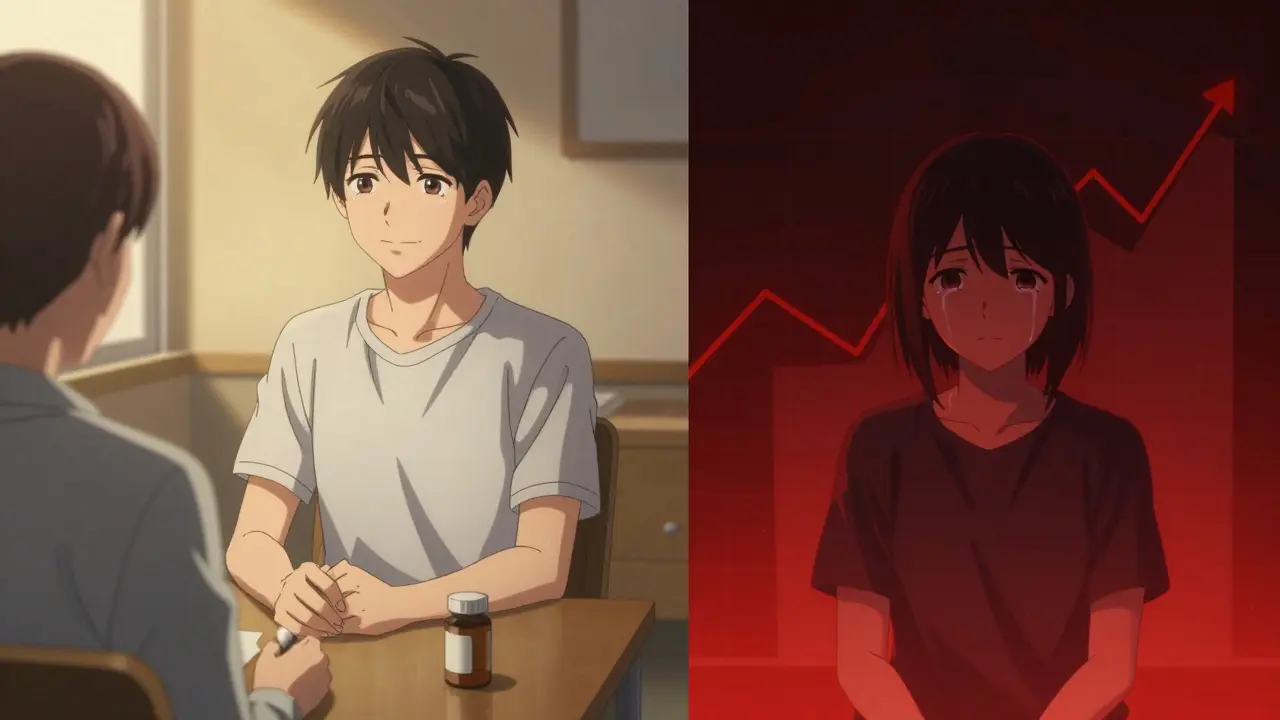
After the warning, antidepressant prescriptions for kids aged 10-19 dropped by 31% within two years. That’s over a million fewer prescriptions annually. At the same time, diagnoses of depression in this age group were rising - not falling. More kids were struggling, but fewer were getting medication.
And then the suicide rates started climbing.
In 2003, the suicide rate for 10- to 19-year-olds in the U.S. was 2.0 per 100,000. By 2007, it had jumped to 3.5 per 100,000 - a 75% increase. The same pattern showed up in young adults after the 2007 expansion. Meanwhile, suicide rates in adults over 25 - who weren’t affected by the warning - stayed steady.
A 2023 study in Health Affairs tracked 1.1 million adolescents across 11 U.S. health plans. They found a 21.7% spike in psychotropic drug poisonings (a proxy for suicide attempts) in the two years after the warning. Among young adults, the spike was 33.7%. These weren’t random fluctuations. They followed the warning like a shadow.
Researchers like Dr. Stephen Soumerai from Harvard Pilgrim Health Care Institute say the data is too consistent to ignore. "The sudden, simultaneous, and sweeping effects - reduced treatment and increased suicide - are not a coincidence," he said.
Why Did This Happen?
The warning did exactly what it was designed to do: scare people. Parents panicked. Doctors hesitated. Some stopped prescribing altogether.
A 2019 survey of 1,200 child psychiatrists found that 87% said the warning made prescribing antidepressants harder. Parents asked more questions, demanded more proof, and often refused treatment. The average time spent explaining the warning jumped from 8 minutes to over 22 minutes per visit.
On online forums like Reddit and HealthUnlocked, parents reported being torn. One parent wrote: "My daughter’s psychiatrist told us the warning was causing more harm than good because families were refusing treatment that could save lives."
Surveys show 74% of parents delayed or refused antidepressants for their kids because of the warning. The biggest fear? "Making suicidal thoughts worse."
But here’s the twist: Among families who still chose treatment despite the warning, 67% reported positive outcomes. Many said the warning actually helped them stay alert - noticing early signs of worsening mood, leading to faster intervention.

The Monitoring Problem
The FDA didn’t just say "be careful." They said: "Monitor closely."
Guidelines called for weekly check-ins during the first month of treatment, bi-weekly for the next month, then regular follow-ups. Sounds reasonable - until you try to do it in real life.
A 2020 study in JAMA Network Open found that only 37% of youth patients received the recommended monitoring. In rural areas? Just 22%. Many families lived hours from a psychiatrist. Insurance didn’t cover frequent visits. Schools didn’t have mental health staff. The warning created a standard no one could consistently meet.
Doctors had to sign extra consent forms. Pharmacies had to hand out guides. Clinics spent more time on paperwork than treatment. And still, most kids didn’t get the close watch the warning demanded.
What Other Countries Did
The U.S. isn’t the only country dealing with this. But others took a different path.
Health Canada kept a similar warning - but added language emphasizing the balance between risk and benefit. They didn’t scare people into inaction. They encouraged informed decisions.
Europe? They never issued a black box warning at all. The European Medicines Agency reviewed the same data and decided the risks didn’t justify a blanket warning for all youth. And guess what? European countries didn’t see the same spike in youth suicides after 2005.
That’s not proof the warning caused the spike. But it’s strong evidence that the U.S. approach - a one-size-fits-all alarm - may have done more harm than good.
The Big Question: Is the Warning Still Necessary?
The FDA still stands by it. They say the original data is solid. The risk is real. And they argue that even a small increase in suicidal thoughts matters.
But here’s the problem: The warning treats every child the same. It doesn’t distinguish between a teen with mild depression and one with severe, chronic suicidal ideation. It doesn’t account for access to therapy, family support, or socioeconomic factors. It just says: "All antidepressants = danger."
Meanwhile, the evidence keeps piling up that the warning has led to fewer treatments and more deaths. A 2022 statement from the American College of Neuropsychopharmacology called for a "careful reassessment." Pharmaceutical companies like Eli Lilly and Pfizer have petitioned the FDA to change the wording.
The FDA held a public meeting in September 2023 to review the data. No decision has been made - yet. But the writing is on the wall. The warning, as it stands, is outdated.
What Parents and Teens Should Do Now
If you’re considering antidepressants for a child or teen, here’s what you need to know:
- The risk of suicidal thoughts is small - about 2 percentage points higher than placebo. Most kids don’t experience it.
- Untreated depression carries a much higher risk of suicide. Depression itself is the biggest danger.
- Medication works - especially when paired with therapy. Studies show combination treatment is more effective than either alone.
- Don’t refuse treatment out of fear. Ask your doctor: "What’s the risk if we don’t treat?"
- Monitor closely - especially in the first 4-8 weeks. Watch for increased agitation, withdrawal, or talk of hopelessness.
- Make sure you have a plan for follow-up. Weekly check-ins matter. If your provider can’t schedule them, find someone who can.
The black box warning was meant to protect. But protection without access to care is just another kind of harm. The goal isn’t to avoid medication. It’s to use it wisely - with awareness, support, and ongoing care.
What’s Next?
Researchers at the National Institute of Mental Health are working on better tools - ones that can predict who’s at real risk, not just blanket every kid with the same warning. Early results are expected in mid-2024. The hope? A future where warnings are targeted, not terrifying.
For now, the choice isn’t between medication and no medication. It’s between informed, monitored treatment - and silence, fear, and untreated illness.
Depression doesn’t wait. Neither should you.




Write a comment
Your email address will be restricted to us