
When a child eats peanut butter for the first time and breaks out in hives within minutes, or an adult develops swelling in their throat after eating shrimp, it’s not just a bad reaction-it’s an IgE-mediated food allergy. This isn’t a simple upset stomach or a mild rash. It’s the immune system sounding a false alarm, treating harmless food proteins like deadly invaders. And when that alarm goes off too hard, it can trigger anaphylaxis-a life-threatening emergency that demands immediate action.
How IgE Reactions Work: The Immune System’s Mistake
Your immune system is designed to protect you. But in people with IgE food allergies, it gets confused. The first time someone is exposed to a food like peanuts, eggs, or shellfish, their body may mistakenly identify a protein in that food as dangerous. Special immune cells called dendritic cells pick up the protein and hand it to T cells, which then tell B cells to make a specific type of antibody: IgE. These IgE antibodies don’t float around freely. They latch onto mast cells and basophils-cells scattered throughout the skin, lungs, gut, and bloodstream. Now the body is primed. The next time that same food is eaten, the protein binds to the IgE on those cells, causing them to explode with chemicals like histamine, leukotrienes, and prostaglandins. Within seconds to two hours, symptoms appear: hives, vomiting, wheezing, dizziness, a drop in blood pressure. That’s an IgE reaction. It’s fast. It’s systemic. And it can kill.What Foods Trigger the Most Reactions?
Not all foods are equal when it comes to triggering IgE reactions. The most common culprits change as you grow older. In young children, milk, eggs, and peanuts top the list. About 2.5% of kids under three are allergic to milk, and nearly 2 in 100 react to peanuts. But many outgrow these. By age 16, 80% of milk and egg allergies fade away. In adults, the game shifts. Shellfish becomes the #1 trigger, affecting nearly 3% of adults. Tree nuts like almonds, walnuts, and cashews are close behind. Unlike childhood allergies, peanut and tree nut allergies rarely go away-only about 1 in 5 people outgrow them. Even more concerning: trace amounts can be enough. Some people react to as little as 1-2 milligrams of peanut protein-roughly the size of a grain of sand. That’s why cross-contamination in kitchens, restaurants, or packaged foods is such a big risk.Prevention Starts Before Birth-And Continues in the First Months
For years, doctors told parents to delay introducing allergenic foods. That advice was wrong. Landmark studies like the LEAP trial (2015) turned everything upside down. Researchers found that high-risk infants-those with severe eczema or egg allergy-who were fed peanut-containing foods between 4 and 11 months had an 81% lower chance of developing peanut allergy by age 5. Now, guidelines from the U.S. National Institute of Allergy and Infectious Diseases (NIAID) say:- High-risk infants (severe eczema or egg allergy): Introduce peanut between 4-6 months, after seeing a specialist.
- Moderate-risk infants (mild to moderate eczema): Introduce peanut around 6 months.
- Low-risk infants: Introduce peanut along with other solids, no need to delay.
Vitamin D, Skin Care, and the Microbiome: New Frontiers in Prevention
Science is now looking beyond food introduction. Researchers are studying how early-life factors shape immune development. Vitamin D appears to play a role. Infants with vitamin D levels above 30 ng/mL have more regulatory T cells-immune cells that help maintain tolerance. Observational studies suggest mothers with vitamin D levels above 75 nmol/L during pregnancy have children with 30% lower odds of food sensitization. A large trial called PREPARE is now testing whether giving pregnant women 4,400 IU of vitamin D daily reduces food allergies by age 3. The ‘farming effect’ is another clue. Kids raised on traditional farms have 25-50% lower allergy rates. Scientists think it’s due to early exposure to diverse bacteria. Now, researchers are testing bacterial lysate supplements-pills containing harmless bacterial parts-to mimic that protective effect. Probiotics? The evidence is mixed. A 2020 Cochrane Review found no clear benefit for preventing food allergies, despite earlier hopes. So while probiotics may help with eczema, they shouldn’t be relied on for allergy prevention.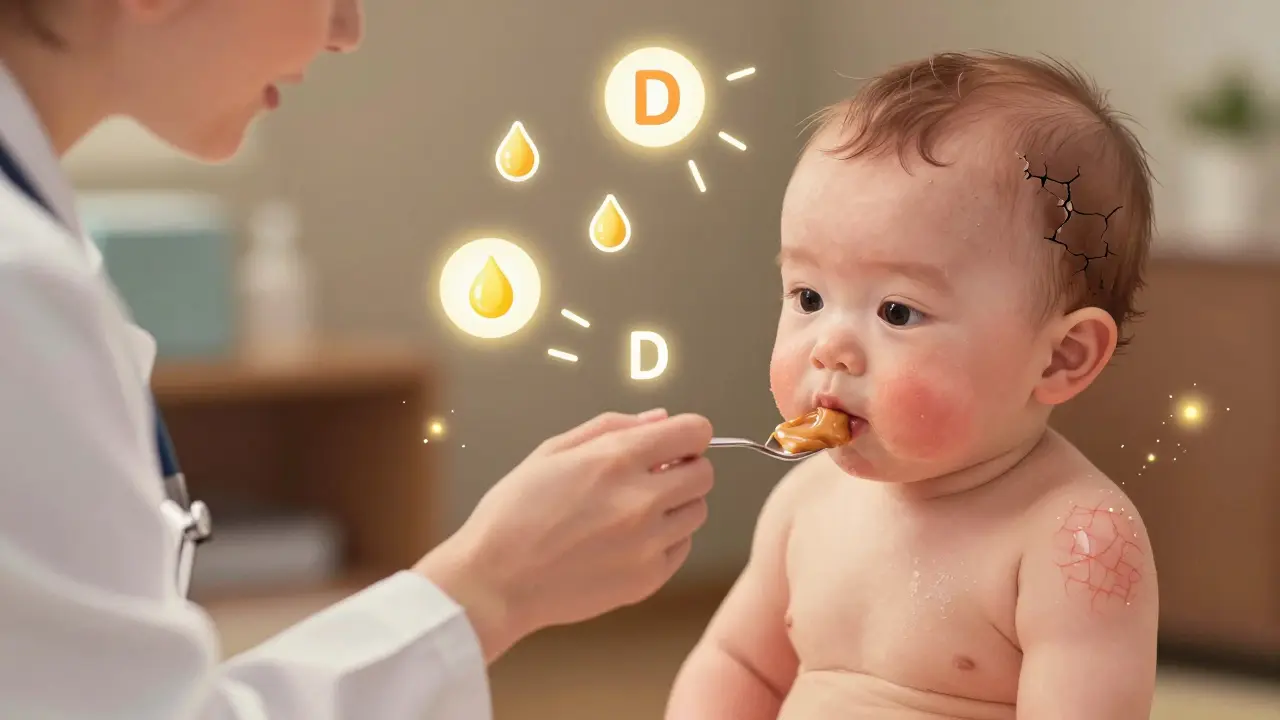
Diagnosis: Testing Isn’t Always Clear-Cut
Just because a skin prick test is positive doesn’t mean the person will react to the food. Many people test positive but can eat the food without issue. That’s why diagnosis needs more than just a test. Skin prick tests measure wheal size. A wheal 3mm bigger than the control is considered positive. But the meaning changes by food: for peanut, an 8mm wheal gives a 50% chance of real allergy. For egg, it’s 7mm. Blood tests for specific IgE (measured in kU/L) help, too. For peanut, a level of 14 kU/L means a 95% chance of clinical allergy. But the real game-changer is component-resolved diagnostics. Instead of testing for the whole peanut protein, doctors now test for specific parts like Ara h 2. If IgE to Ara h 2 is above 0.35 kU/L, there’s a 95% chance the person will have a severe reaction. The only way to be 100% sure? An oral food challenge. But these are risky. About 1 in 7 people need epinephrine during the test. So they’re done in controlled settings with emergency equipment ready.Anaphylaxis: The Emergency You Must Prepare For
Anaphylaxis doesn’t wait. It hits fast. Symptoms can include:- Swelling of the lips, tongue, or throat
- Wheezing or trouble breathing
- Dizziness, fainting, or a rapid drop in blood pressure
- Severe vomiting or diarrhea
Managing Allergies Long-Term: Immunotherapy and New Hope
Avoidance is still the rule-but it’s not enough. Accidental exposures happen to 50-80% of children with peanut allergy over five years. And 25-35% of those exposures lead to reactions needing epinephrine. Oral immunotherapy (OIT) is changing that. Palforzia, an FDA-approved peanut powder for kids 4-17, helps 67% of users tolerate the equivalent of two peanuts after months of daily dosing. It’s not a cure-it’s desensitization. You still need to avoid peanuts, but if you accidentally eat a little, you’re less likely to crash. Sublingual immunotherapy (SLIT), where a drop of allergen sits under the tongue, works too-about half of patients can handle 3-4 peanuts after two years. And omalizumab (Xolair), an anti-IgE drug, is now used alongside OIT to reduce side effects and speed up the process. Emerging therapies are even more exciting. Peptide immunotherapy uses tiny pieces of allergens to trigger tolerance without full reactions. Nanoparticles deliver allergens in a way that avoids IgE binding. And drugs like dupilumab, which blocks key inflammation signals, are being tested to help patients reach lasting tolerance.
Prognosis: Will Your Child Outgrow It?
The good news? Many kids outgrow milk and egg allergies. The bad news? Peanut and tree nut allergies stick around. A key predictor? Tolerance to baked forms. Kids who can eat muffins with egg or cheese in pizza are far more likely to outgrow the allergy. One study found that children who tolerated baked milk had a 75% chance of outgrowing it within three years-compared to just 35% for those who couldn’t. Component testing also helps predict outcomes. If a child’s IgE targets heat-labile proteins (like Gal d 1 in egg), they’re more likely to outgrow it. If it’s the heat-stable ones (like Gal d 2), the allergy is more likely to last.What You Can Do Today
If you’re a parent:- Don’t delay peanut or egg introduction. Talk to your pediatrician by 4-6 months.
- Use emollients daily if your baby has eczema.
- Keep vitamin D levels checked-especially during pregnancy and infancy.
- Get an epinephrine auto-injector prescribed if there’s any risk of reaction.
- Practice using the trainer device every month. Know the signs of anaphylaxis.
- Carry two epinephrine auto-injectors. Always.
- Read labels-even if you’ve eaten the product before. Ingredients change.
- Teach family, coworkers, and friends how to use your injector.
- Consider OIT if you’re a candidate. It’s not for everyone, but it’s life-changing for many.







Write a comment
Your email address will be restricted to us