
Imagine looking at the world through a warped funhouse mirror. Straight lines curve, lights flare into starbursts, and no matter how strong your glasses prescription gets, everything stays blurry. This is daily life for many people with keratoconus, a progressive eye condition where the cornea thins and bulges into a cone shape. It’s not just bad eyesight; it’s structural damage to the clear front window of your eye. But here is the good news: you don’t have to accept poor vision. For most patients, rigid contact lenses, hard lenses that create a smooth optical surface over the irregular cornea are the game-changer that restores clarity.
Understanding Keratoconus: More Than Just Bad Vision
Keratoconus isn't something you catch like a cold, nor is it caused by reading in dim light. It is a biological process involving the breakdown of the cornea's structure. Normally, your cornea is round and smooth, like a basketball. In keratoconus, the collagen fibers weaken, often due to an imbalance of enzymes that break down tissue faster than the body can repair it. The cornea starts to thin and push forward, forming a cone-usually at the center or slightly below the center.
This condition typically shows up during the teenage years or early twenties, though it can appear later. It almost always affects both eyes, but rarely equally. One eye might be significantly worse than the other. The progression usually slows down and stops by your forties. If left unchecked, the extreme irregularity causes severe astigmatism and myopia (nearsightedness) that standard glasses simply cannot correct. Glasses sit away from the eye; they can fix simple focusing errors, but they cannot mask the chaotic scattering of light caused by a bumpy, cone-shaped cornea.
Why Rigid Lenses Are the Gold Standard
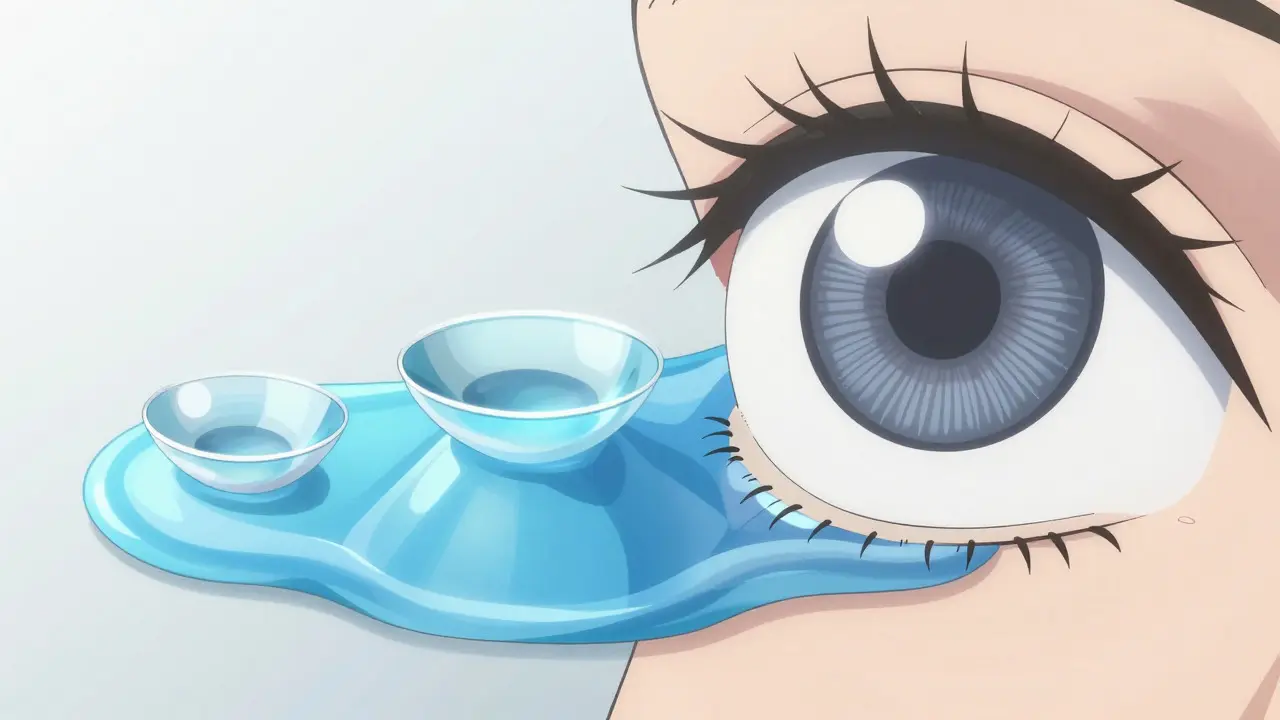
If glasses fail, why do soft contact lenses often struggle too? Soft lenses conform to the shape of your eye. If your cornea is bumpy and cone-shaped, a soft lens drapes over those bumps like a fitted sheet on a lumpy mattress. You still see the irregularities. Rigid lenses work differently. They are stiff enough to hold their own shape. When a rigid lens sits on your eye, it creates a new, perfectly smooth surface. The space between the back of the lens and the front of your cornea fills with tears. This tear layer acts as a fluid cushion that optically neutralizes the corneal irregularities. Light passes through the smooth lens and the uniform tear film, resulting in sharp, clear vision.
There are three main types of rigid lenses used for keratoconus:
- Rigid Gas Permeable (RGP): These are traditional hard lenses, typically 9-10mm in diameter. They rest directly on the cornea. They offer excellent oxygen permeability (Dk values ranging from 50-150), which keeps the cornea healthy, but they can feel gritty at first because they move with every blink.
- Hybrid Lenses: As the name suggests, these combine a rigid center for crisp vision with a soft outer skirt for comfort. They bridge the gap between RGPs and soft lenses, making them a popular choice for patients who find pure RGPs too uncomfortable.
- Scleral Lenses: These are larger lenses, typically 15-22mm in diameter. Instead of resting on the cornea, they vault over the entire corneal surface and rest on the white part of the eye (the sclera). Because they don't touch the sensitive cornea, they are incredibly comfortable. The large reservoir of fluid underneath provides stability and hydration, making them ideal for advanced keratoconus or dry eyes.
| Lens Type | Diameter | Comfort Level | Best For |
|---|---|---|---|
| RGP | 9-10mm | Low to Moderate (requires adaptation) | Mild to moderate keratoconus |
| Hybrid | Variable | Moderate to High | Patient struggling with RGP comfort |
| Scleral | 15-22mm | High (does not touch cornea) | Advanced keratoconus, dry eye, post-surgery |
The Adaptation Process: What to Expect
Let’s be honest: putting on a rigid lens feels strange at first. About 30% of patients report initial discomfort, describing a "foreign body sensation" or feeling like there is sand in their eye. This is normal. Your brain has to learn to ignore the presence of the lens. The key is patience and a structured wearing schedule.
Don’t try to wear them for eight hours on day one. Start small. Wear them for two to four hours, then take them off. Increase the wear time by one or two hours each subsequent day. Most people achieve comfortable, full-time wear within two to four weeks. During this period, you might experience some lens awareness or difficulty with insertion and removal. Practice makes perfect. Use plenty of preservative-free rewetting drops if your eyes feel dry, and ensure you are cleaning the lenses thoroughly to prevent fogging or irritation.
If you switch from RGPs to scleral lenses, the comfort jump is often immediate. Since scleral lenses rest on the less sensitive sclera, the "gritty" feeling is largely eliminated. However, fitting scleral lenses is more complex. It requires specialized equipment and expertise. Look for a provider certified in systems like PROSE (Prosthetic Replacement of the Ocular Surface Ecosystem) or similar advanced scleral designs.

Halting Progression: Cross-Linking and Surgery
Rigid lenses fix the vision problem, but they don’t stop the disease from getting worse. To halt the progression of keratoconus, doctors use corneal cross-linking (CXL), a procedure that strengthens corneal bonds using riboflavin and UV light. FDA-approved in 2016, CXL has a 90-95% success rate in stopping progression. Think of it as reinforcing the walls of a weakening building. You often need both: CXL to stop the cone from growing, and rigid lenses to correct the vision distortion that already exists.
In cases where lenses fail or scarring occurs, surgical options exist. INTACS implants are ring segments inserted into the cornea to flatten the cone. Corneal transplantation (PK or DALK) replaces damaged tissue entirely. However, transplants carry risks like graft rejection and require long recovery times. Fortunately, only about 10-20% of keratoconus patients ever need a transplant. For the vast majority, a combination of cross-linking and rigid lenses provides a stable, high-quality life.
Troubleshooting Common Issues
Even with the best fit, issues can arise. Here is how to handle common problems:
- Lens Fogging: If your vision blurs after a few hours, protein buildup might be the culprit. Switch to a cleaner designed for rigid lenses or use enzymatic cleaners weekly.
- Decentration: If the lens slides off-center, your vision will distort. This often happens if the lens fit is too loose or if your eyelids are pulling it out of place. See your fitter for adjustments.
- Dry Eye: Keratoconus often coexists with dry eye. Scleral lenses are excellent here because they keep the cornea bathed in fluid. If using RGPs, use frequent preservative-free drops.
Do rigid lenses cure keratoconus?
No, rigid lenses do not cure keratoconus or stop its progression. They are a visual rehabilitation tool that masks the irregular corneal shape to provide clear vision. To halt the disease progression, treatments like corneal cross-linking (CXL) are required.
How long does it take to get used to rigid lenses?
Most patients adapt within 2 to 4 weeks. Initial discomfort is common, affecting about 30% of users. Starting with short wear times (2-4 hours) and gradually increasing daily helps your brain adjust to the lens sensation.
Are scleral lenses better than RGP lenses for keratoconus?
Scleral lenses are generally more comfortable because they rest on the white of the eye rather than the cornea. They have higher success rates in advanced cases (85% vs 65% for RGPs in stage III-IV keratoconus) and are ideal for patients with dry eyes or significant corneal irregularity.
Can I wear rigid lenses if I have had corneal cross-linking?
Yes, absolutely. In fact, many patients undergo cross-linking to stabilize their cornea and then use rigid lenses to correct their vision. The two treatments complement each other effectively.
What should I do if my rigid lens falls out?
If your lens falls out, locate it immediately on a clean surface. Rinse it with solution, inspect for cracks, and reinsert it. If it breaks or scratches, replace it. Frequent loss may indicate a poor fit, so consult your eye care provider for adjustments.