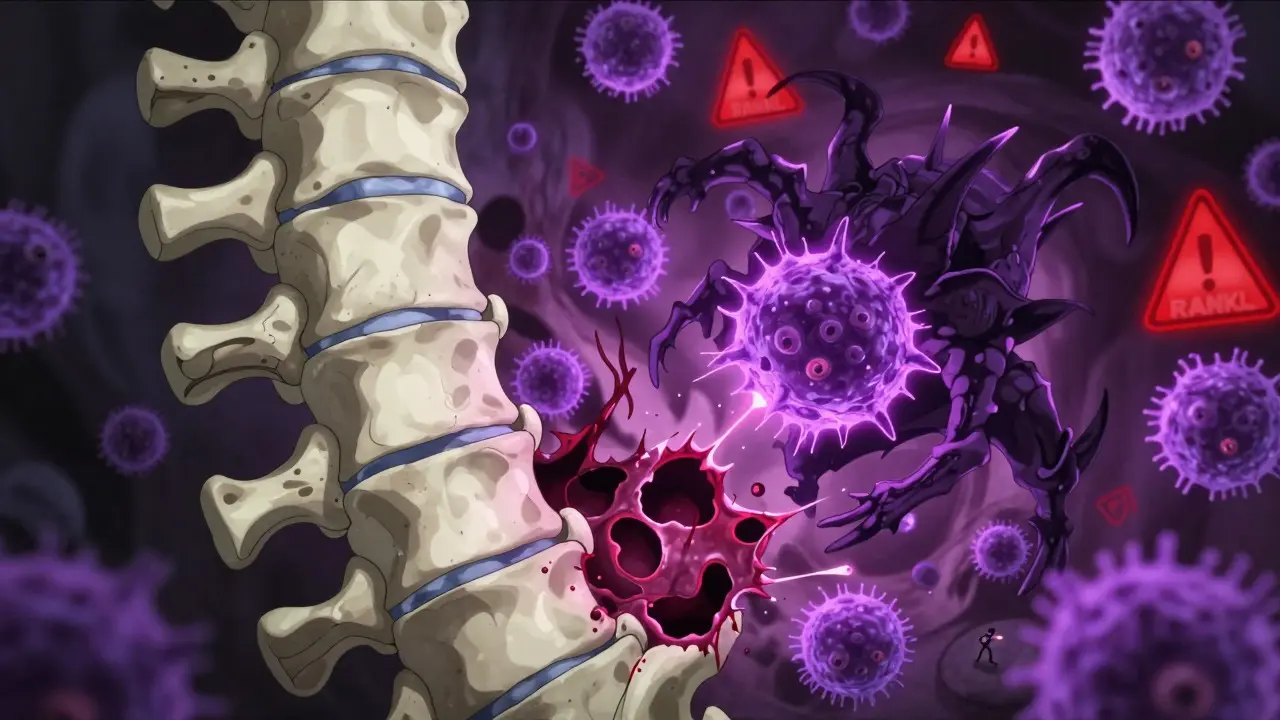
You wake up with a sharp pain in your back. It’s not just muscle strain; it’s the hallmark of Multiple Myeloma a cancer of plasma cells that causes severe bone damage. For over 80% of patients, this isn't just a side effect-it's the primary source of suffering. While survival rates have improved dramatically thanks to new therapies, the skeleton often remains a battlefield. The traditional approach has been to stop the bleeding, so to speak, by halting bone loss. But what if we could actually heal the bones? That is the promise of the next generation of treatments.
The Vicious Cycle of Bone Destruction
To understand why standard treatments sometimes fall short, you have to look at what is happening inside the bone marrow. In healthy bones, there is a constant balance between two types of cells: Osteoclasts, which break down old bone, and Osteoblasts, which build new bone. In multiple myeloma, this balance collapses. Myeloma cells hijack the local environment, forcing osteoclasts into overdrive while simultaneously suppressing osteoblasts. This results in "punched-out" holes in the bone, known as osteolytic lesions, which do not heal on their own.
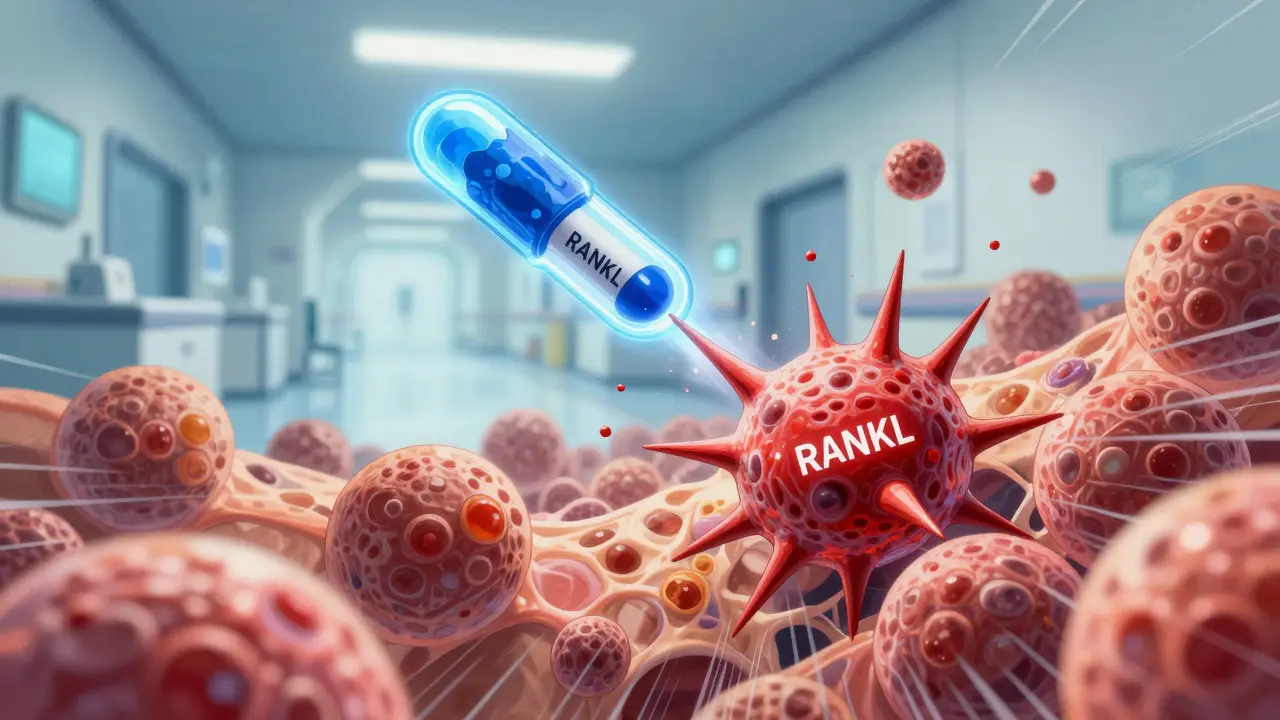
The mechanism behind this destruction involves specific molecular pathways. The most critical one is the RANK/RANKL/OPG axis. Myeloma cells increase the production of RANKL, a protein that signals osteoclasts to activate. At the same time, they reduce OPG, a decoy receptor that normally keeps RANKL in check. The result? A significantly elevated RANKL/OPG ratio-often three to five times higher than in healthy individuals-which drives aggressive bone resorption. Furthermore, myeloma cells secrete inhibitors like DKK1 and sclerostin, which block the Wnt signaling pathway needed for osteoblast function. Essentially, the tumor creates a microenvironment where bone is destroyed faster than it can be rebuilt, creating a vicious cycle where bone breakdown releases growth factors that further fuel the cancer.
Current Standard of Care: Stopping the Loss
For years, the gold standard for managing Myeloma Bone Disease (MBD) has been bisphosphonates, such as zoledronic acid or pamidronate. These drugs work by attaching to bone surfaces and inhibiting osteoclast activity. They are effective at reducing skeletal-related events (SREs), which include pathological fractures, spinal cord compression, and the need for radiation or surgery. However, they come with drawbacks. Bisphosphonates require intravenous infusion, carry a risk of kidney toxicity, and can cause jaw osteonecrosis (MRONJ), a painful condition where the jawbone fails to heal.
| Treatment Type | Mechanism of Action | Administration | Key Benefits | Limitations |
|---|---|---|---|---|
| Zoledronic Acid | Inhibits osteoclasts | IV Monthly | Proven efficacy, low cost | Kidney toxicity, MRONJ risk, no bone formation |
| Denosumab | RANKL inhibitor | Subcutaneous Monthly | No renal clearance needed, convenient | Hypocalcemia risk, high cost |
| Romosozumab | Anti-sclerostin (dual action) | Subcutaneous Monthly | Increases bone density, stimulates formation | Cardiovascular risk monitoring required |
| Anti-DKK1 Agents | Blocks Wnt inhibition | IV/Subcutaneous | Potential for true bone healing | Still in clinical trials |
A significant shift occurred with the introduction of Denosumab. Unlike bisphosphonates, denosumab is a monoclonal antibody that targets RANKL directly. It prevents osteoclast activation without binding to the bone matrix itself. This means it doesn't accumulate in the kidneys, making it safer for patients with renal impairment-a common issue in myeloma. Studies show denosumab reduces SREs slightly better than zoledronic acid and offers the convenience of subcutaneous injection rather than an IV drip. Despite these advantages, adoption varies globally due to cost differences, with usage rates significantly higher in the United States compared to Europe and Asia.
The Next Frontier: Healing the Bone
While stopping bone loss is crucial, it doesn't fix the holes already there. Patients still suffer from chronic pain and structural weakness because the body cannot rebuild the lost bone. This is where novel agents come in. Researchers are now targeting the suppression of osteoblasts directly, aiming to restart the building process. One promising candidate is Romosozumab, an antibody against sclerostin. Sclerostin is a protein produced by osteocytes that inhibits bone formation. By blocking it, romosozumab unleashes the osteoblasts' potential to build new bone.
In the STRUCTURE trial, romosozumab demonstrated a 53% increase in bone mineral density at the lumbar spine in myeloma patients. This is a game-changer because previous treatments only slowed decay; this agent actively promotes reconstruction. Similarly, therapies targeting DKK1 (Dickkopf-1) aim to restore the Wnt signaling pathway. Early-phase trials with anti-DKK1 antibodies have shown reductions in bone resorption markers and hints of bone healing, though large-scale phase III data is still pending. Another avenue involves gamma-secretase inhibitors, which target the Notch pathway involved in osteoclast differentiation. While preclinical models show impressive reductions in osteolytic lesions, human application is still in early stages.

Managing Side Effects and Quality of Life
Treating bone disease isn't just about lab values; it's about how the patient feels. Persistent bone pain affects nearly 70% of patients, even those on standard therapy. Medication-related osteonecrosis of the jaw (MRONJ) remains a feared complication, affecting a subset of patients on long-term antiresorptive therapy. Preventive dental care before starting treatment is non-negotiable. If you are prescribed zoledronic acid or denosumab, get a dental checkup first. Any invasive dental procedures should ideally be completed before therapy begins.
Another concern is hypocalcemia, particularly with denosumab. Because the drug shuts down bone breakdown, calcium levels in the blood can drop. Regular monitoring and supplementation with calcium and vitamin D are essential. Patients often report fatigue and acute phase reactions (flu-like symptoms) after initial doses of bisphosphonates, but these usually diminish over time. With newer agents, the side effect profiles differ. Romosozumab requires careful cardiovascular monitoring, as some studies suggested a slight increase in heart attack or stroke risk, although this was primarily seen in post-menopausal women with existing risks. Personalized medicine approaches are emerging, using biomarkers like DKK1 levels to predict who might benefit most from specific targeted therapies.
Practical Steps for Patients and Caregivers
If you or a loved one is facing a diagnosis of multiple myeloma with bone involvement, here is a roadmap to navigate the complexities:
- Baseline Imaging: Ensure you have a whole-body low-dose CT or PET-CT scan. X-rays often miss early lesions, delaying appropriate intervention.
- Dental Clearance: Schedule a comprehensive dental exam within 30 days of starting bone-modifying agents to mitigate MRONJ risk.
- Renal Monitoring: If using bisphosphonates, monitor creatinine clearance regularly. Dose adjustments are necessary if kidney function declines.
- Calcium Supplementation: Take daily calcium and vitamin D supplements unless contraindicated, especially when on denosumab or romosozumab.
- Pain Management: Don't ignore persistent pain. Discuss multimodal pain strategies, including physical therapy and nerve blocks, alongside medication.
The landscape of myeloma care is shifting from mere disease control to holistic quality-of-life improvement. By combining tumor-targeting therapies with bone-healing agents, we are moving toward a future where skeletal complications are no longer a defining feature of the disease. Keep an eye on clinical trials; participation may provide access to cutting-edge treatments like anti-sclerostin or anti-DKK1 therapies before they become widely available.
Why do myeloma bone lesions not heal like normal fractures?
Myeloma bone lesions are purely osteolytic, meaning they involve bone destruction without any attempt at repair. Unlike typical fractures, where the body sends osteoblasts to build a callus, myeloma cells suppress osteoblast function through molecules like DKK1 and sclerostin. This uncoupling of bone remodeling means the bone is eaten away but never replaced, leading to permanent 'punched-out' holes.
Is denosumab better than zoledronic acid for myeloma bone disease?
Denosumab is generally preferred for patients with kidney problems because it is not cleared by the kidneys, unlike zoledronic acid. It also offers the convenience of subcutaneous injection versus intravenous infusion. However, zoledronic acid is significantly cheaper and has a longer track record. Both drugs effectively reduce skeletal-related events, but neither promotes bone healing. Choice depends on renal function, cost, and insurance coverage.
What is medication-related osteonecrosis of the jaw (MRONJ)?
MRONJ is a rare but serious side effect of potent bone-strengthening drugs like bisphosphonates and denosumab. It occurs when the jawbone loses its blood supply and dies, often triggered by tooth extractions or poor oral hygiene. Prevention is key: maintain excellent dental health and complete necessary dental work before starting these medications.
Can new agents actually reverse bone damage in myeloma?
Emerging agents like romosozumab (anti-sclerostin) and anti-DKK1 therapies show promise in stimulating bone formation, potentially reversing some damage. Clinical trials have demonstrated increases in bone mineral density. However, widespread clinical use is still limited, and long-term data on whether these agents fully restore structural integrity in myeloma patients is still being gathered.
How does hypercalcemia relate to myeloma bone disease?
When bone is broken down rapidly by osteoclasts, calcium is released into the bloodstream. In myeloma, this process is excessive, leading to hypercalcemia (high blood calcium). Symptoms include confusion, thirst, nausea, and constipation. Treating the underlying bone disease with agents like denosumab or bisphosphonates helps lower calcium levels, along with hydration and steroids.






Write a comment
Your email address will be restricted to us