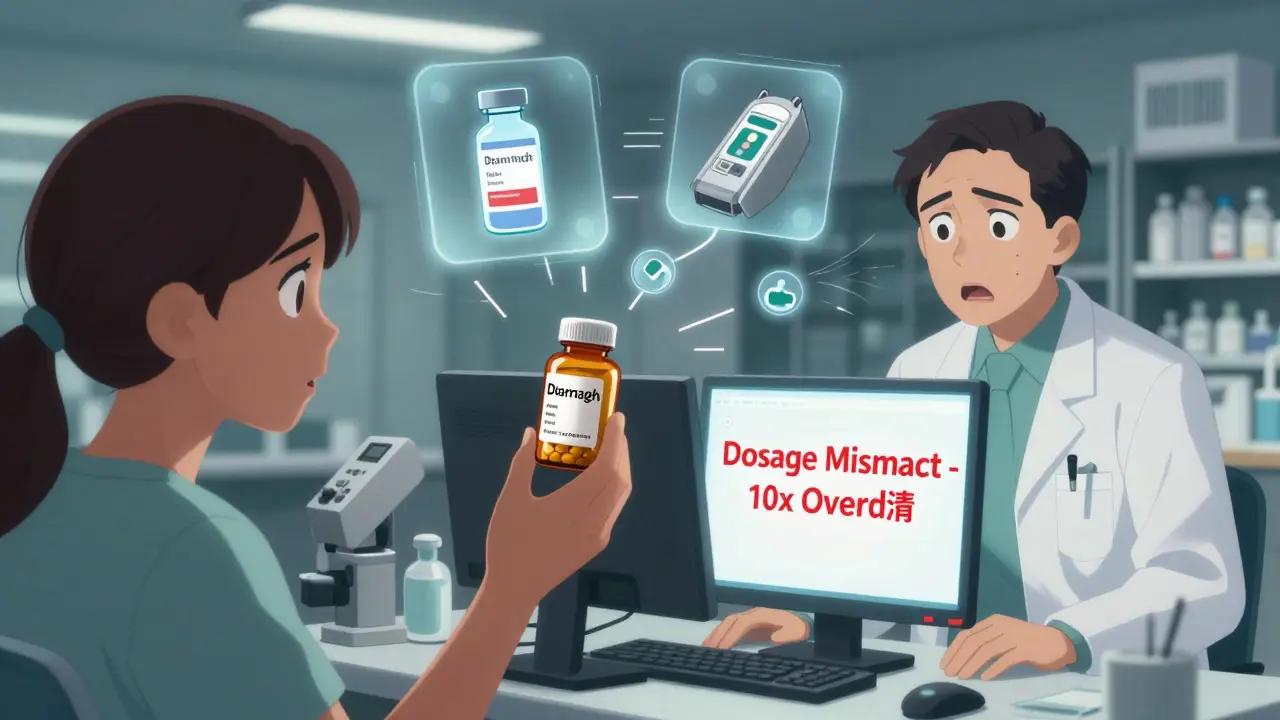
Getting the wrong medication or incorrect dosage from a pharmacy isn’t just a mistake-it can be life-threatening. A 2021 study found that pharmacy errors cause over 1.5 million injuries each year in the U.S., and nearly half of those could have been prevented. Yet, most people never report these errors. Why? Many don’t know how. Others fear retaliation or think it won’t make a difference. The truth? Reporting matters. It’s not about blaming a pharmacist-it’s about fixing the system so no one else gets hurt.
What Counts as a Pharmacy Error?
A pharmacy error isn’t just getting the wrong pill. It includes:- Wrong medication dispensed (e.g., you asked for lisinopril, got losartan)
- Incorrect dosage (e.g., 10 mg instead of 5 mg)
- Wrong directions on the label (e.g., “take once daily” when it should be twice)
- Missing or incorrect warning labels (e.g., no alert about alcohol interaction)
- Wrong patient-your prescription given to someone else
- Expired or contaminated medication
- Failing to warn you about dangerous drug interactions
Even if you didn’t take the medication, if the error could have caused harm, it counts. These aren’t rare. In 2022, the FDA received over 1.3 million reports of adverse events, and roughly 8% were medication errors from pharmacies. That’s tens of thousands of preventable mistakes.
Where and How to Report a Pharmacy Error
You have several options, depending on where you live and what kind of error occurred. Here’s how to navigate them.1. Report to the FDA’s MedWatch Program
The FDA MedWatch is the federal system for reporting serious medication errors and adverse events. It’s open to anyone-patients, family members, or caregivers. You don’t need to be a doctor.
How to file:
- Go to the FDA MedWatch portal and select Form 3500 (for consumers).
- Fill in details: what happened, when, which pharmacy, your age (not full name), and the medication involved.
- Upload a copy of the prescription or pill bottle if you have it.
- Submit online, or call 1-800-FDA-1088.
Over 85% of reports are filed online. The FDA processes these in about 5.2 business days on average. But here’s the catch: they don’t call you back. Only 29% of reporters get any follow-up. That doesn’t mean your report didn’t help. The FDA uses this data to spot trends-like a spike in errors with a certain drug or pharmacy chain-and pushes for system-wide fixes.
2. Report to the Institute for Safe Medication Practices (ISMP)
ISMP MERP is a confidential, non-punitive reporting system focused on understanding why errors happen. Unlike the FDA, ISMP talks to you. They follow up with questions to dig into the root cause: Was the pharmacist rushed? Was the label unclear? Was there a software glitch?
Why report here?
- You’ll get a thank-you email with a summary of how your report helped.
- They analyze about 12,000 reports a year and publish real-world safety alerts.
- Reports are protected under federal law-you can’t be sued for reporting.
How to file:
- Call 1-800-233-7767 or visit ismp.org/report.
- Describe what happened in detail: “I picked up my insulin, but the label said 100 units/mL instead of 50 units/mL.”
- Include environmental details: “The pharmacy was backed up. Two pharmacists were on break.”
ISMP’s analysis helped fix a dangerous error pattern in 2023 when multiple reports revealed that a popular insulin brand’s label was being misread due to font size. They issued a nationwide alert. That’s how reporting saves lives.
3. Report to Your State Pharmacy Board
If you live in California, New York, Texas, or another state with a strong pharmacy board, you can file a formal complaint. These boards can investigate, fine pharmacies, or even suspend licenses.
California’s Board of Pharmacy, for example, received 1,842 complaints in 2021. Of those, 217 led to disciplinary action. You’ll need to submit:
- Completed online form or PDF (available in English and Spanish at pharmacy.ca.gov)
- Copy of the prescription
- Original pill bottle (if still available)
- Authorization to release medical records (if needed)
By law, they must acknowledge your report within 14 days. You can track your case online since August 2022. The average resolution time dropped from 127 days to 89 days after they added real-time tracking.
4. Report to the Pharmacy Itself
Don’t skip this step. Talk to the pharmacist. Ask to speak with the manager. Say: “I want to understand how this happened so it doesn’t happen again.”
Many pharmacies have internal reporting systems. CVS, Walgreens, and Walmart log every error-even near-misses. In 2022, CVS reported over 28,000 internal errors. That’s not because they’re bad-it’s because they’re trying to fix things.
One real example: A woman in Ohio reported that her Walmart pharmacy gave her a 10x overdose of thyroid medication. She called, spoke to the manager, and they immediately recalled the batch. Within 24 hours, ISMP got a report. Within a week, the pharmacy changed its scanning protocol. No one else got hurt.
What Happens After You Report?
Most people assume reporting leads to punishment. It doesn’t. The goal isn’t to fire someone-it’s to fix the system.
- State boards may investigate, interview staff, review training logs, and inspect pharmacy practices. If they find negligence, they can fine the pharmacy or suspend the pharmacist’s license.
- ISMP publishes anonymized case studies and sends alerts to pharmacies nationwide. For example, after multiple reports of mislabeled epinephrine auto-injectors, ISMP worked with manufacturers to redesign labels.
- The FDA adds your report to a database used to identify patterns. If 50 people report the same error with a specific drug from one chain, the FDA can issue a safety alert or require labeling changes.
- Pharmacy chains may retrain staff, update software, or change workflow. One chain switched to double-checking high-risk medications after 17 reports in 3 months.
But here’s the reality: only 14.3% of serious medication errors are ever reported. Fear, confusion, and apathy are the biggest barriers. A 2023 survey found that 41% of people didn’t report because they didn’t know how. 29% thought it wouldn’t matter. 18% feared retaliation.

What You Can Do If Nothing Changes
If you reported and got no response, don’t give up. Try another channel. For example:
- If you reported to the FDA but heard nothing, file with ISMP.
- If your state board didn’t respond in 60 days, call them. Ask for the case number and supervisor.
- If the pharmacy refuses to acknowledge the error, file a HIPAA complaint if your private health info was mishandled (must be done within 180 days).
Also, keep records. Save your prescription, pill bottle, pharmacy receipt, and any emails or notes from conversations. If the error caused harm-like a hospital visit or emergency room trip-those documents can help you seek compensation or support future reports.
Why Reporting Matters More Than You Think
Pharmacy errors aren’t just about one bad day. They’re symptoms of deeper problems: understaffing, outdated software, poor training, or rushed workflows. One report might not fix it. But 100 reports? 1,000? That’s how change happens.
Consider this: In 2021, 12 different people reported the same error with a specific generic blood pressure drug. The label looked identical to another drug. ISMP flagged it. The manufacturer changed the label design. Now, thousands of patients are safer.
That’s the power of reporting. It’s not revenge. It’s prevention.

Common Myths About Reporting Pharmacy Errors
- Myth: “I’ll get sued if I report.” Truth: Federal law protects reporters. You can’t be retaliated against.
- Myth: “The pharmacy will be shut down.” Truth: Most errors are fixed with training, not punishment.
- Myth: “Only doctors can report.” Truth: Anyone can report-patients, family, friends.
- Myth: “It’s too late if it happened last year.” Truth: You have up to 12 months in most states to report.
Quick Checklist: How to Report a Pharmacy Error
- Stay calm. Don’t take the medication if you suspect a mistake.
- Call the pharmacy. Ask to speak to the manager. Document the conversation.
- Save everything: pill bottle, prescription, receipt, label.
- Choose your reporting channel: FDA, ISMP, state board, or all three.
- Be specific: What happened? When? Why do you think it happened?
- Follow up. If you don’t hear back in 30 days, call again.
- Report near-misses too. “I almost took the wrong dose” counts.
Can I report a pharmacy error if I didn’t get hurt?
Yes. In fact, reporting near-misses is critical. Many serious errors are caught before harm happens. The FDA and ISMP use these reports to find patterns and prevent future accidents. A report like “I almost took 10x my dose” could save someone else’s life.
How long do I have to report a pharmacy error?
In most states, you have at least 12 months. The FDA accepts reports anytime, even years later. But the sooner you report, the more useful your information is. Evidence fades, staff move on, and systems change. Report within 30 days for the best impact.
Will the pharmacy know I reported them?
Not necessarily. ISMP and the FDA keep reports confidential. Your name is never shared with the pharmacy unless you give written permission. State boards may notify the pharmacy as part of an investigation, but they don’t reveal your identity unless required by law.
What if the pharmacy refuses to acknowledge the error?
That’s common. Don’t take it personally. Go straight to your state pharmacy board or ISMP. They have legal authority to investigate. Provide all documentation-even a photo of the wrong label helps. Most boards require proof, not just a complaint.
Can I report an error from a mail-order pharmacy?
Yes. Mail-order pharmacies are regulated by the state where they’re licensed. Report to that state’s pharmacy board. You can also report to the FDA and ISMP. Include the pharmacy’s name, address, and any tracking numbers from your shipment.
Do I need a lawyer to report a pharmacy error?
No. Reporting is a public safety step, not a legal one. You don’t need a lawyer to file with the FDA, ISMP, or your state board. Only consider legal help if you suffered serious harm and want compensation. Reporting alone doesn’t require legal action.
What Comes Next? The Bigger Picture
Change is coming. In 2024, the FDA is launching a mobile app for easier reporting. Congress is debating a national mandatory reporting law. AI tools are being tested to catch errors before they leave the pharmacy. But none of this works unless patients speak up.
Every report you file adds to a growing database of safety data. That data shapes policy, changes training, improves technology, and saves lives. You’re not just reporting a mistake-you’re helping build a safer system for everyone.






Write a comment
Your email address will be restricted to us