When you pick up a prescription, you might not think about who made the pill or how much it cost to produce. But behind every generic drug and every brand-name drug is a very different story-especially when it comes to labor. The truth is, generic drugs don’t cost less because they’re made by cheaper workers. They cost less because they’re made differently-by design.
Why Generic Drugs Are So Much Cheaper
Generic drugs are copies of brand-name drugs. They contain the same active ingredients, work the same way, and meet the same safety standards. But their prices? Often 80% lower. That’s not magic. It’s math. The biggest reason? Generic manufacturers don’t pay for research and development. Developing a new drug takes about 10 to 15 years and costs an average of $2.6 billion. Brand-name companies have to recoup that money. Generic makers skip that step entirely. They don’t need to fund clinical trials or pay for marketing campaigns to convince doctors to prescribe a new molecule. That alone removes the biggest chunk of cost. But even after you remove R&D, labor still plays a huge role in the final price. And here’s where things get interesting.Labor Costs: Brand vs Generic
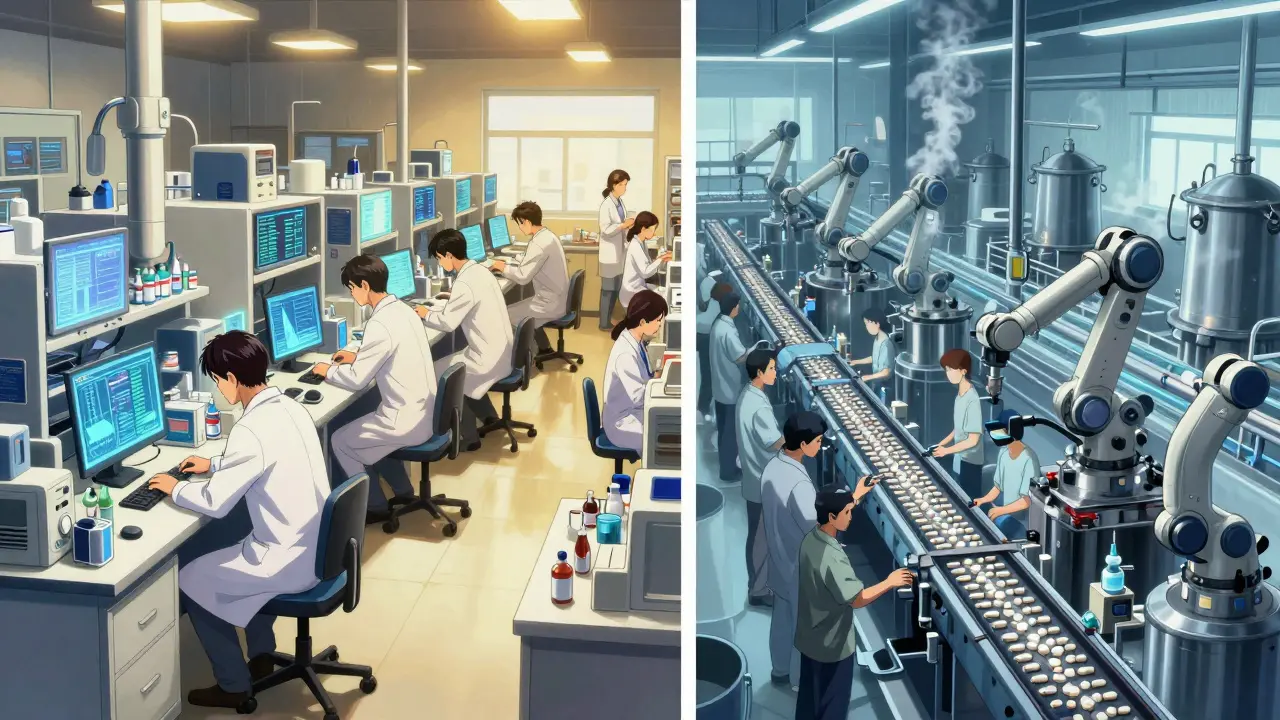
For brand-name drugs, labor makes up 30% to 40% of total production costs during early manufacturing. That’s because these drugs are often made in smaller batches, with complex processes, strict quality controls, and teams of scientists and engineers monitoring every step. Every change in the formula? It’s tested again. Every batch? It’s reviewed by multiple departments. The process is meticulous-and expensive. Generic drug production? Labor accounts for only 15% to 25% of total costs. Why? Scale. Volume. Repetition. A generic manufacturer might produce 10 million tablets of the same 50mg pill every week. That kind of volume changes everything. When production volume doubles, unit labor costs drop by 27% on average for generics. For brand-name drugs, the same doubling only cuts costs by 17%. That’s because generics are built for repetition, not innovation. Think of it like this: making one custom-made suit takes hours of skilled labor. Making 10,000 identical suits on an assembly line? Each one takes minutes. The skill level doesn’t disappear-but the time per unit drops dramatically.Quality Control: The Hidden Labor Cost
Don’t be fooled into thinking generic drugs are lower quality because they’re cheaper. The FDA requires them to be bioequivalent-meaning they work the same in your body. That’s not easy to prove. Quality control alone eats up more than 20% of generic drug production costs. That’s not just machines running tests. That’s people. Lab technicians checking raw materials. Supervisors reviewing batch records. Analysts running chromatography tests to confirm purity. Documentation clerks logging every step for traceability. A medium-sized generic manufacturer spends about $184,000 a year just on compliance systems. Add in $1.9 million for program participation and $320,000 per new drug application, and you’re looking at a labor-heavy regulatory machine. The difference? Brand-name companies do this once. Generic companies do it for every single product they make. So while brand-name labor costs are tied to innovation and complexity, generic labor costs are tied to volume and compliance. Both are expensive-but in different ways.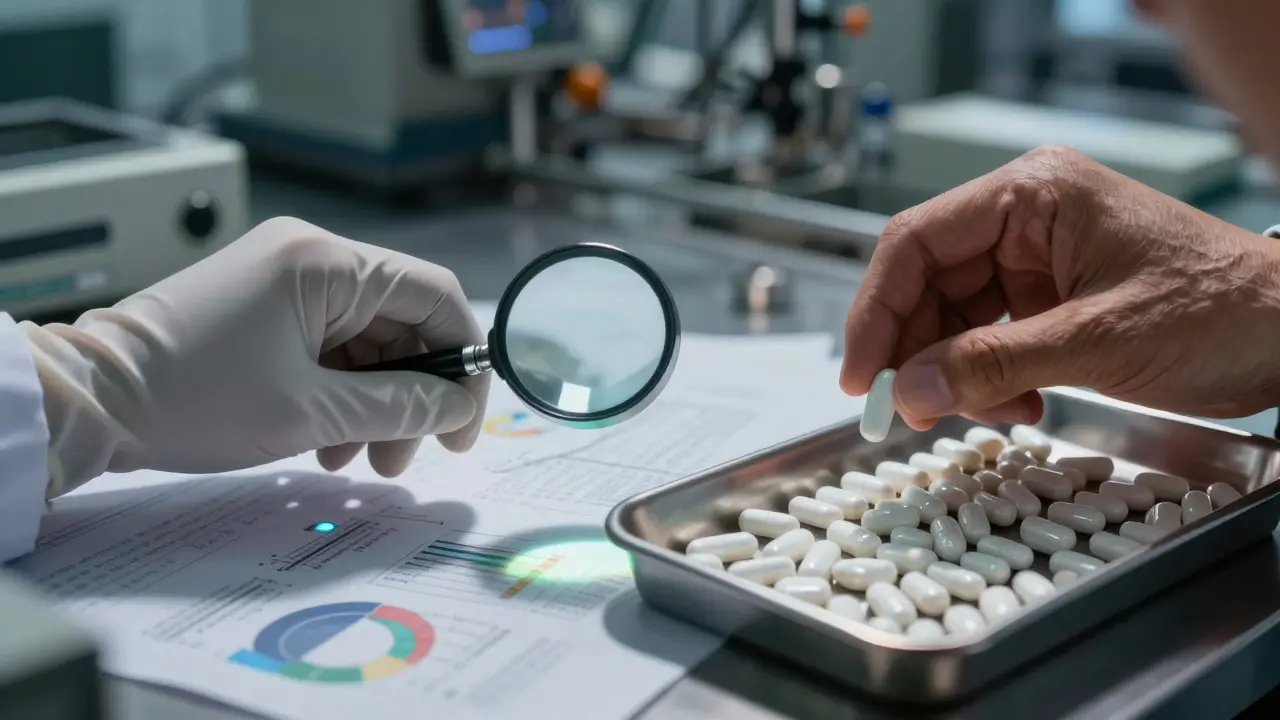
Where the Work Happens: Global Labor Arbitrage
A big part of why generic drugs are cheap? They’re often made overseas. Active pharmaceutical ingredients (APIs)-the actual medicine in the pill-are produced in India and China at roughly 42% less cost than in the U.S. That’s not because workers there are more skilled. It’s because labor standards, environmental rules, and even energy costs are lower. The U.S. Department of Health and Human Services calls this “structural distortion.” It’s not efficiency-it’s cost shifting. That 42% savings applies directly to the 36% of generic drug costs tied to production. That’s where most of the labor is: in the factories, not the labs. So when you buy a generic pill, you’re not just saving on R&D. You’re also saving on the wage gap between a U.S. pharmaceutical technician and one in Hyderabad. But here’s the catch: this global model creates risks. When a single factory in India shuts down for an inspection, or when tariffs rise, or when a country changes export rules, shortages happen. The FDA has warned that pressure to cut costs can lead to understaffing, rushed inspections, and quality issues. The race to the bottom on labor isn’t sustainable.Outsourcing and the Rise of Contract Manufacturers
More and more generic companies are outsourcing production entirely. Instead of owning factories, they hire Contract Manufacturing Organizations (CMOs). In biosimilar production, 42% of costs go to CMOs. For small-molecule generics, it’s still 28%. This shift turns fixed labor costs into variable ones. No need to pay for a full-time team when demand dips. No need to train workers for a product that might be discontinued next year. The CMO absorbs the labor burden-and the risk. But this also means less control. If a CMO cuts corners to stay profitable, the generic drug maker might not know until it’s too late. That’s why the FDA is watching closely. They’ve seen what happens when profit pressure overrides quality.






Write a comment
Your email address will be restricted to us