
Chronic pain doesn’t just hurt-it steals your life. You can’t sleep well, move freely, or enjoy the little things. Medications help for a while, but side effects pile up. Physical therapy gives temporary relief. Surgery feels too risky. That’s where nerve blocks and radiofrequency ablation (RFA) come in. These aren’t magic fixes, but they’re two of the most effective, evidence-backed tools in modern pain management-especially for people with stubborn back, knee, or neck pain.
How Nerve Blocks Work (And Why They’re the First Step)
A nerve block is simple: a doctor injects a local anesthetic-sometimes mixed with a steroid-right next to a nerve that’s sending pain signals. Think of it like flipping a temporary switch. The numbing effect kicks in within minutes and lasts anywhere from a few hours to a few weeks. It’s not meant to cure anything. It’s meant to tell you something: Is this nerve the source of your pain?
Let’s say you have lower back pain that radiates into your hip. Your doctor suspects it’s coming from the facet joints-the small bones in your spine that move when you bend. They inject a small amount of numbing medicine near the nerves feeding those joints. If your pain drops by 80% or more, that’s a clear signal: those nerves are the problem. If not? Then the pain’s coming from somewhere else. This diagnostic step is critical. Skipping it means you’re guessing. And guessing leads to wasted time, money, and unnecessary procedures.
Doctors use real-time X-ray imaging (fluoroscopy) to guide the needle. It’s not a shot in the dark. It’s precise. And because you’re awake during the procedure, you can tell the doctor right away if the pain changes. No guesswork. No surprises.
Radiofrequency Ablation: Turning Temporary Relief into Long-Term Relief
Now, imagine you had a nerve block that worked beautifully. Your pain vanished for three weeks. You felt like yourself again. But then it came back. That’s where RFA steps in. Instead of numbing the nerve temporarily, RFA gently heats it-just enough to disrupt its ability to send pain signals. Think of it like resetting a faulty wire.
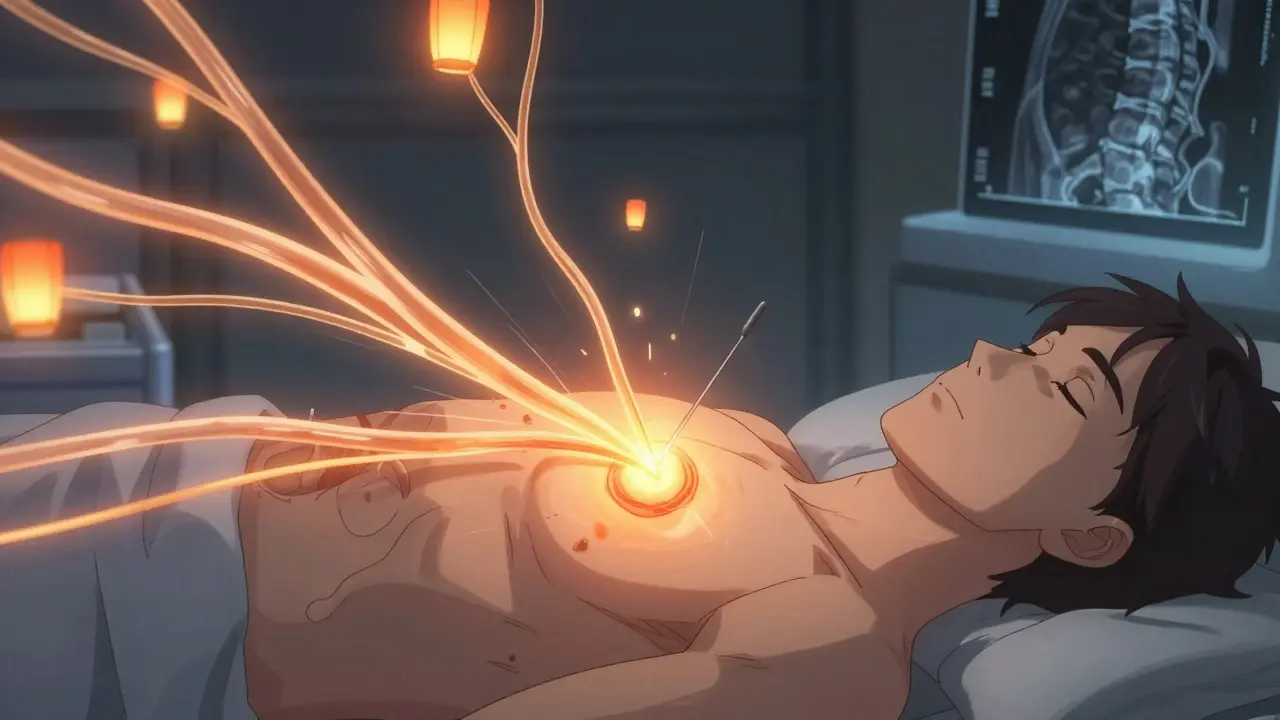
The procedure uses a thin needle, guided by live X-ray, to reach the exact nerve. Once it’s in place, a small electrical current passes through the tip, heating it to 80-90°C. That heat creates a tiny, controlled lesion on the nerve. It doesn’t destroy the nerve completely-just enough to stop the pain signals for months.
Here’s what most people don’t realize: RFA doesn’t work on everyone. It only works if the diagnostic nerve block worked first. If you didn’t get significant relief from the numbing shot, RFA won’t help either. That’s not a flaw-it’s a feature. It ensures you’re only treating the right nerve.
The whole procedure takes 20 to 45 minutes. You’re sedated but awake. No general anesthesia. No hospital stay. Most people walk out the same day.
What to Expect After RFA
You might feel sore for a few days. Some people describe it like a bad muscle ache. That’s normal. The nerve is healing around the lesion. Full pain relief usually takes 2 to 4 weeks. It doesn’t happen overnight. Your body needs time to adjust.
Most patients report 50% or more pain reduction. Studies show 85% of well-selected patients get meaningful relief. And here’s the big win: 70% reduce or stop using opioids after RFA. That’s not just pain relief-it’s a return to independence.
You can usually go back to light activity the next day. Full recovery? Most people are back to work within 3 days. No long rehab. No braces. No major downtime.
RFA vs. Nerve Blocks: The Real Difference
People often confuse these two. Here’s the clearest way to see the difference:
- Nerve Block: Temporary relief (hours to weeks). Uses medicine to block signals. Good for diagnosis and short-term comfort.
- RFA: Long-term relief (6 to 24 months). Uses heat to disable the nerve. Good for lasting results after a successful block.
Let’s say you have chronic knee pain from osteoarthritis. A cortisone injection might ease your pain for 6 weeks. RFA? It can give you 6 to 12 months of relief. A 2023 NCBI study found 65% of patients with knee pain still had significant improvement at the 6-month mark after RFA. Cortisone? Only 45% at 3 months.
And compared to surgery? RFA is far less risky. Spinal fusion requires months of recovery, has a 10-15% complication rate, and costs $30,000-$60,000. RFA? $3,000-$5,000. Outpatient. Same-day return home.
Where RFA Works Best (And Where It Doesn’t)
RFA isn’t a one-size-fits-all solution. It shines in specific areas:
- Facet joint pain (back and neck): 70-80% success rate. The most common use.
- Knee osteoarthritis: Cooled RFA (a newer version) gives relief for up to 6 months in 65% of patients.
- Sacroiliac joint pain: 70% success at 6 months.
- Occipital neuralgia (headache pain): Emerging evidence shows strong results.
But RFA won’t help if your pain comes from:
- Advanced arthritis with bone-on-bone damage
- Nerve compression from a herniated disc (you might need surgery)
- Pain caused by tumors or infections
It’s not a cure. It’s a way to silence the pain signal-not fix the broken joint. That’s why it’s part of a bigger plan: physical therapy, weight management, activity modification. RFA buys you time to rebuild strength without pain.
What’s New in RFA Technology
It’s not the same procedure it was 10 years ago. Two big advances are changing outcomes:
- Cooled RFA: Uses a special needle that circulates coolant inside. This lets doctors create a larger, more effective lesion without burning surrounding tissue. It’s especially helpful for larger nerves like those in the knee.
- Pulsed Radiofrequency (PRF): Instead of heat, it uses short bursts of electrical energy to modulate nerve activity. No tissue destruction. Less risk. Great for sensitive areas. Recovery is even faster.
The FDA approved the first pulsed-field ablation system for spinal pain in 2022. That’s a game-changer. It’s non-thermal, meaning no heat damage at all. Early results show promise for patients who didn’t respond to traditional RFA.
Who Should Consider RFA?
If you’re dealing with chronic pain and:
- Medications aren’t working or cause side effects
- You’ve tried physical therapy without lasting results
- You’ve had a diagnostic nerve block that gave you clear, significant relief
- You want to avoid surgery or long-term opioid use
Then RFA might be your next best step.
It’s especially effective for people aged 45-65 with lower back pain from facet joints. Studies show 75% success in this group. And with opioid prescriptions dropping 22% among Medicare patients who got RFA, it’s not just about comfort-it’s about safety.

Common Misconceptions
Let’s clear up a few myths:
- Myth: RFA is surgery. Truth: It’s a minimally invasive procedure. No incisions. No stitches.
- Myth: It works forever. Truth: Nerves can regenerate. Relief lasts 6-24 months. You might need a repeat.
- Myth: It’s dangerous. Truth: Complication rates are under 5%. The biggest risk? Doing it without a proper diagnostic block first.
- Myth: It’s only for back pain. Truth: It’s now used for knees, hips, necks, and even headaches.
What Happens If It Doesn’t Work?
It happens. About 20-30% of RFA procedures don’t work-not because the technique failed, but because the diagnostic nerve block was misleading. Maybe the pain was coming from more than one source. Maybe the injection missed the target. That’s why imaging and expert technique matter so much.
Good clinics won’t do RFA unless you’ve had a successful diagnostic block. They’ll also check your medical history, imaging, and response patterns before proceeding. If RFA doesn’t help, they’ll explore other options: spinal cord stimulation, physical therapy upgrades, or even surgical evaluation.
How long does pain relief last after RFA?
Most people get relief for 6 to 24 months. It depends on the nerve treated, your body’s healing response, and whether the underlying condition (like arthritis) keeps progressing. Cooled RFA tends to last longer than traditional RFA, especially for larger nerves like those in the knee.
Is RFA better than a nerve block?
They serve different purposes. A nerve block gives short-term relief and helps diagnose the pain source. RFA is for long-term pain control after a successful nerve block. If you need months of relief instead of weeks, RFA is the better option. But you need a good diagnostic block first.
Can RFA be repeated?
Yes. Nerves can regenerate over time. If pain returns after 6-12 months, a repeat RFA is often safe and effective. Many patients get 2-3 treatments over several years without complications.
Does RFA hurt?
You’ll feel a pinch when the needle goes in, and maybe some pressure. But you’re sedated and numbed. Most patients say it’s less uncomfortable than a root canal. Afterward, there’s mild soreness for a few days-like a bruise. No major pain.
Are there side effects of RFA?
Side effects are rare. The most common is temporary soreness at the injection site (3-7 days). A small number of people (5-10%) get neuritis-nerve inflammation-which can cause tingling or burning for 1-2 weeks. Serious complications like nerve damage or infection are extremely rare when done by experienced providers using imaging guidance.
Who should avoid RFA?
People with active infections, bleeding disorders, or uncontrolled diabetes should delay RFA. Also, if you haven’t had a successful diagnostic nerve block, RFA isn’t recommended. It’s not a first-line treatment-it’s a second-line option after conservative therapies fail.
Final Thoughts: It’s About Choosing the Right Tool
Chronic pain isn’t a single problem. It’s a chain reaction. A damaged joint. Inflamed nerves. Muscle guarding. Stress. Sleep loss. No single treatment fixes it all. But RFA and nerve blocks are two of the most powerful tools we have to break the cycle.
They’re not flashy. They don’t make headlines. But for thousands of people-people who can’t sleep, can’t walk, can’t work-they make all the difference. The key? Proper selection. The right diagnosis. And a doctor who knows when to use each tool.
If you’ve been stuck in the loop of pills, shots, and physical therapy with no lasting relief, it might be time to ask: Could a nerve block help me find the source? And if it does-could RFA help me keep the relief?









Write a comment
Your email address will be restricted to us